
In the precision manufacturing industry, stainless steel non-standard assembly parts are widely used in medical devices, aerospace, high-end hardware equipment, and automated machinery due to their corrosion resistance, high strength, and flexible adaptability. However, due to the “non-standard” characteristics of these workpieces—complex shapes (including deep holes, blind holes, irregularly shaped surfaces, narrow slits, and other structures), varying sizes, and small batch sizes—the polishing process often becomes a bottleneck in the production chain. Traditional polishing methods are either inefficient and inconsistent, or they damage workpiece precision, often leaving companies in a “time-consuming, labor-intensive, and thankless” dilemma.Solving the Polishing Challenges of Stainless Steel Assembly Parts.
Today, we will focus on the pain points of polishing non-standard stainless steel assembly parts, dissecting the limitations of traditional processes and revealing how Crown Magnetic Polishers, through technological innovation, provide efficient and reliable solutions to this problem.
- Why is polishing non-standard stainless steel assembly parts so challenging?
The “non-standard” nature of non-standard assembly parts dictates the unique polishing requirements. Unlike traditional standard parts (such as bolts and washers of uniform specifications), these parts may incorporate various structures, such as bends, gears, grooves, and cross holes. Even within the same batch of workpieces, dimensional variations can occur. This complexity presents three core challenges in the polishing process:
- Perfectly polishing complex structures without blind spots
Deep holes (depth > 10 times the hole diameter), the bottom of blind holes, and narrow gaps (width < 2mm) are difficult to reach with traditional tools (such as sanding belts and scouring pads). Manual polishing requires repeated probing with a slender grinding head, which is time-consuming and prone to leaving blind spots, ultimately resulting in uneven surface roughness.
- Poor batch consistency and high rework rates
Non-standard parts are often produced in small batches. Manual polishing relies heavily on the craftsman’s experience. Even slight deviations in force and angle can result in over-polishing (darkness) or under-polishing (residual burrs) on the workpiece surface, resulting in substandard fit during assembly and the need for secondary rework.
- Low Efficiency and High Cost
Polishing a single part can take from 30 minutes to several hours, requiring frequent tool changes and waste removal. For urgent orders, labor bottlenecks can directly impact delivery cycles, indirectly driving up overall costs.
II. Why are traditional polishing methods “inadequate”?
To address the polishing of non-standard parts, companies often try the following methods, but the results are often unsatisfactory:
- Manual polishing: Relying on technician experience, it is inefficient (long polishing time per part), inconsistent (large variations in polishing results between workers), and produces severe dust pollution. Long-term operation can easily lead to occupational hazards.
- Mechanical tumble polishing/vibration polishing: Suitable for regular workpieces, but the irregular shapes of non-standard parts can lead to uneven collisions, excessive wear in some areas, and incomplete treatment in others.
- Chemical polishing: Acid etching removes surface burrs, but it is difficult to precisely control the etching depth, which can easily lead to dimensional deviations in the workpiece. Furthermore, waste acid disposal is costly and environmentally unfriendly.
III. Guangu Magnetic Polisher: “High-Tech” for Polishing Complex Structures
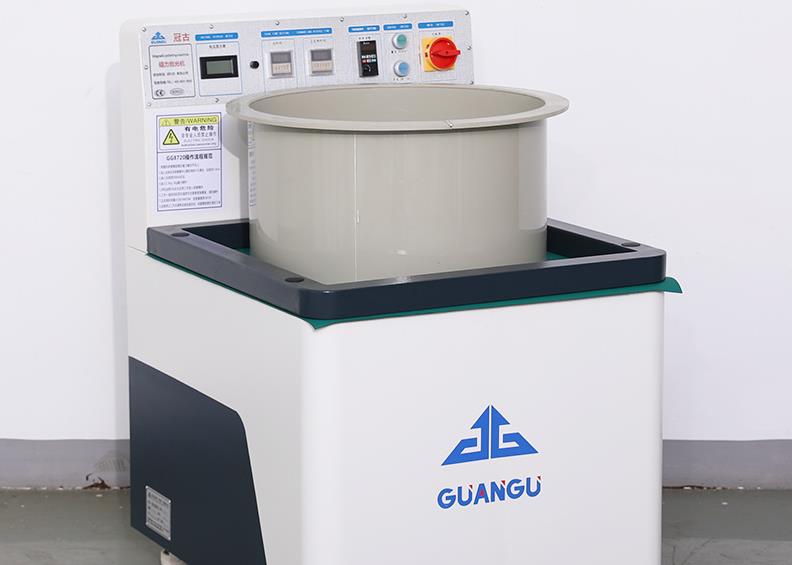
Addressing the pain points of polishing non-standard stainless steel components, the Guangu magnetic polisher utilizes the innovative principle of “magnetic field drive + flexible abrasives,” achieving an upgrade from “manual experience-driven” to “machine-driven intelligent execution,” completely resolving the challenges of polishing complex structures. Its core advantages can be summarized in four points:
- Complete coverage, easily handling complex structures
The core of the magnetic polisher is magnetic abrasive (composed of an iron-based alloy sintered with abrasives). During operation, the machine uses a high-frequency alternating magnetic field to drive the abrasive group to rotate and tumble at high speed, forming a “flexible grinding layer.” Even deep holes, blind holes, cross slots, and other areas inaccessible to traditional tools, the abrasive can penetrate with the magnetic field, evenly removing burrs and oxide layers, achieving 360° polishing without blind spots.

Case study: A medical equipment manufacturer was producing non-standard stainless steel connectors (including a φ3mm deep hole with a 0.5mm radius transition surface). After traditional manual polishing, visible burrs remained at the bottom of the deep hole. By switching to a Guangu magnetic polisher, processing time per part was reduced to 8 minutes, and the surface roughness inside the hole was reduced from Ra1.6μm to Ra0.4μm, fully meeting assembly precision requirements.Solving the Polishing Challenges of Stainless Steel Assembly Parts.
- Automated Parameter Control, Significantly Improved Consistency
The Guangu magnetic polisher supports digital parameter settings (such as magnetic field intensity, abrasive speed, and processing time). Simply inputting a fixed program ensures highly consistent polishing results for the same batch of workpieces. The machine also features a real-time monitoring system that automatically adjusts the abrasive’s trajectory to avoid local over- or under-polishing caused by workpiece clamping deviations.
Comparative testing showed that the dimensional tolerance of 100 non-standard parts polished manually fluctuated within ±0.02mm, while the Guangu machine reduced this fluctuation to ±0.005mm, reducing the defect rate from 8% to 0.5%.
- Flexible Grinding, Preserving Workpiece Precision
Unlike hard-contact polishing (such as grinding wheels), the “soft grinding” properties of magnetic abrasives enable precise control of removal volume (removing only a few microns of surface layer per process). For functional structures on non-standard parts (such as sealing grooves and mating surfaces), the equipment can remove burrs without compromising the original dimensional accuracy, ensuring a secure fit and seal during assembly.
- Environmentally Friendly and Efficient, with Visible Cost Reductions
- Improved Efficiency: Single-part processing time is reduced by over 70% compared to manual labor. For small-batch, high-mix production, the equipment can operate 24/7 and replace 5-8 skilled workers.
- Reduced Costs: No frequent tool changes or waste cleaning are required, and the abrasive loss rate is less than 5% (reusable over 50 times), resulting in a 40% reduction in overall costs compared to traditional processes.
- Green and Safe: No chemical reagents are consumed, only a small amount of recyclable metal debris is generated, and dust concentration in the workshop is reduced by 90%, meeting environmental standards.
IV. Advantages of Choosing a Guangu Magnetic Polishing Machine-Solving the Polishing Challenges of Stainless Steel Assembly Parts
In addition to its core technological advantages, Guangu has also optimized its products for non-standard parts production scenarios:
- Flexible loading: Supports a variety of tooling, including hangers, trays, and baskets, to accommodate workpieces of varying shapes and sizes;
- Quick changeover: The parameter storage function can save over 100 process recipes, allowing for one-click recall when switching between products, reducing commissioning time;
- Intelligent maintenance: The equipment’s built-in fault diagnosis system predicts the lifespan of key components (such as magnetic poles and coils), minimizing downtime losses.
Conclusion: Choosing the right equipment for non-standard polishing means choosing competitive advantage
Polishing non-standard stainless steel components is no longer simply a matter of polishing the surface—it is directly related to product yield, delivery efficiency, and customer trust. Guangu’s magnetic polishing machines, with their technological breakthroughs of “no blind spots, high consistency, and increased efficiency,” provide companies with a polishing solution that transitions from passive solutions to proactive control.
If you are worried about the polishing efficiency, cost, or quality of non-standard parts, you might want to give the Guangu magnetic polisher a try. After all, in the field of precision manufacturing, efficient equipment is the most reliable “polishing weapon” for enterprises.Solving the Polishing Challenges of Stainless Steel Assembly Parts.


You must be logged in to post a comment.